
Unlock value from your international supply chain
Most companies have international suppliers - whether goods and / or services - and most treat their international suppliers similarly to domestic.
Taking a different approach to your international supply chain can deliver significant benefits.
Why? Put simply:
Distance = risk
Companies that treat their international suppliers differently can unlock significant benefits for themselves.
Unlock value by helping suppliers in your international supply chains.
This post explains why there is value to unlock and how to go about it.
What challenges do international suppliers face?
At the time of writing, Donald Trump has just been reversed by the US Supreme Court on tariffs and has just imposed a flat rate 15% global tariff on US imports, replacing his hand-crafted regime under IEEEA.
By the time you read this post - it might all have changed again. But we don't need even to explore that topic here. Whilst tariff risks are certainly present, there can be more fundamental challenges that international suppliers face:
Will the buyer pay?
When might the buyer pay?
What do I do if there is a dispute with the buyer?
How can I finance any trade credit the buyer requires?
These are questions which are much easier to answer when the buyer is in the same country as the supplier. In that case, the buyer credit will likely be well understood by the supplier's bankers, any disputes would be addressed under a common legal system, and the buyer and suppliers speak the same language and are in the same time zone.
But when the buyer is overseas, the picture can change significantly.
Payment risks
For good reason, most buying groups will approach suppliers with a "one-size-fits-all" model.
If the corporate standard is a 90 day payment term, then that is the default that suppliers are expected to provide.
Standard terms and conditions for purchase orders and contracts are likely to use the buyer's choice of law - likely its domestic legal system.
Payments will be made in the buyer's currency (or maybe in USD) - but probably not in the currency of the supplier's country.
Underlying all of this is a more subtle issue - which is when suppliers can be confident of the amount the buyer will pay. Most buyers only consider how much to pay after goods are delivered - rather than earlier when goods are shipped.
That can leave suppliers waiting for days or even weeks for clarity on whether the buyer might propose deductions from the invoice.
On top - if there were to be disputes about payment, then the supplier would face a battle with overseas lawyers, winning arguments based on the buyer's legal system and in the buyer's local courts. It can be a mountain to climb.
The costs that international suppliers face
These various uncertainties and frictions make it expensive for international suppliers to provide credit to their international buyers.
It is not just a question of the buyer's credit standing or reputation. Local banks and financiers in the supplier's country are rightly cautious about giving high advance rates against international invoices, whether or not these are "confirmed" by the buyer, and whether or not the buyer's credit is excellent.
This means most suppliers are providing credit terms to international buyers that are partly (or even wholly) financed by their equity capital.
And these costs get factored into the prices that buyers are paying for the goods and services that they are ordering.
The big value win for international supply chains
There is a better way to manage international suppliers.
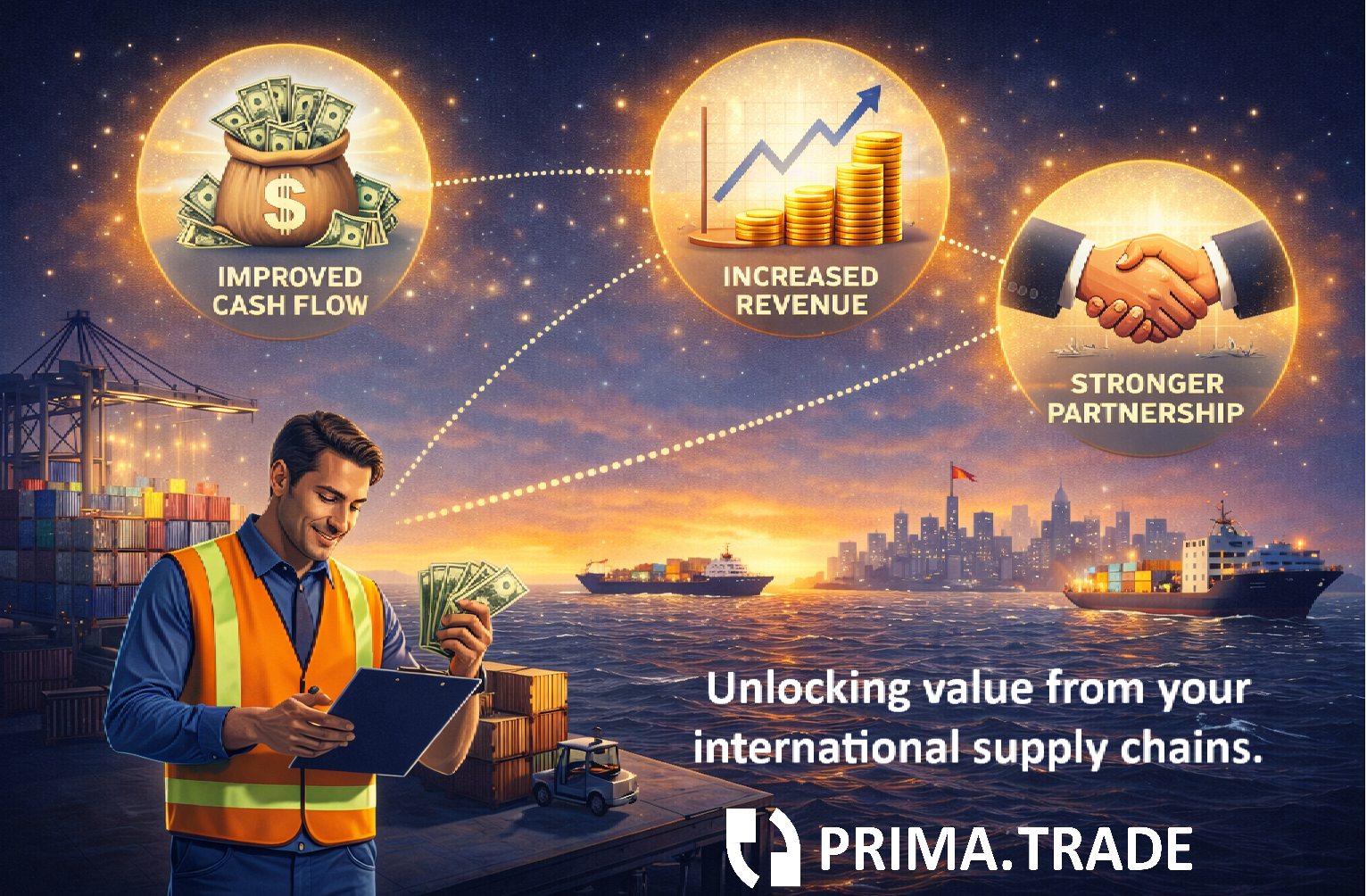
Given the much higher costs involved in deferred payment terms, the answer is to get cash to international suppliers as quickly as possible against their invoices.
The quicker payments are made, the more value the buyer can obtain.
And the new generation of supply chain finance platforms supports this process by enabling buyers to approve invoices for payment very quickly, with high levels of automation and at shipment (ie: before delivery).
How does that work?
Most buyers operate a standard "3-way match" to approve invoices for payment and decide on any deductions necessary. That is match between invoices, purchase orders and delivery.
The PrimaTrade platform replicates that approach, but delivers the 3-way match at shipment using trade digitization. What's matched are invoices, purchase orders and digitised shipping documents.
This approach is not new. It is how trade credit has worked almost forever, for example using letters of credit or documentary collections.
Most companies have moved away from these banking products because of cost and complexity; but trade digitisation technologies mean buyers can quite easily review shipping documents in real-time, directly digitised by suppliers.
There is no need to use the banking channels, and that same data can also be used to automate processes.
The value delivered
The savings involved are significant.
PrimaTrade clients are generally obtaining a 1%+ discount on the cost of the goods that are being shipped by monetising the efficiency of instant payments.
This is easy to do on the PrimaTrade platform using the "cash against data" model:
Suppliers agree a discount with the buyer for instant payment.
Buyers approve invoices for instant payments based on the shipping document 3-way match.
That instant payment to the supplier can be funded externally via existing or new supply chain finance programs.
And the platform automatically captures the difference between the supplier discount and the funding cost as a debit note posted to the buyer's ERP.
The trade digitisation process also delivers process wins for the buyer:
In the accounts payable team because suppliers are matching purchase orders to invoices electronically on the platform and digitising invoices - so these tasks no longer need to be done by the buyer at head office.
In the customs and logistics team because that same supplier data can be used to automate import customs filings, reducing the need to use third party customs brokers and forwarders.
International supply chains - worth the effort
These are material wins for buyers flowing straight to their bottom line.
Increasingly banks are recognising that international supply chain finance is a product that their customers want - and the award-winning "cash against data" approach is also recognised by the ICC.
PrimaTrade's platform is now being endorsed and recommended by a number of major European banking groups directly to their clients for international supply chains - typically in retail and manufacturing.
There is much more to this topic. If you would like to talk to us - or see if any of our partner banks would be happy to provide you with a limit - do get in touch here: