
Shari'a compliant supply chain finance
As many of us know well, Islamic culture expects financial structures to be set up in specific ways to avoid various harms, including the charging of interest and the use of financing in support of unacceptable activities.
Trade finance, factoring and supply chain finance are all types of financing which, with careful attention to details, can be set up to comply with many of the principles of Islamic financing.
Shari'a compliant supply chain finance is a native capability of the PrimaTrade platform - and this short note explains some of the principles behind the structures we typically support.
The structure described here is known as a "Musharakah".
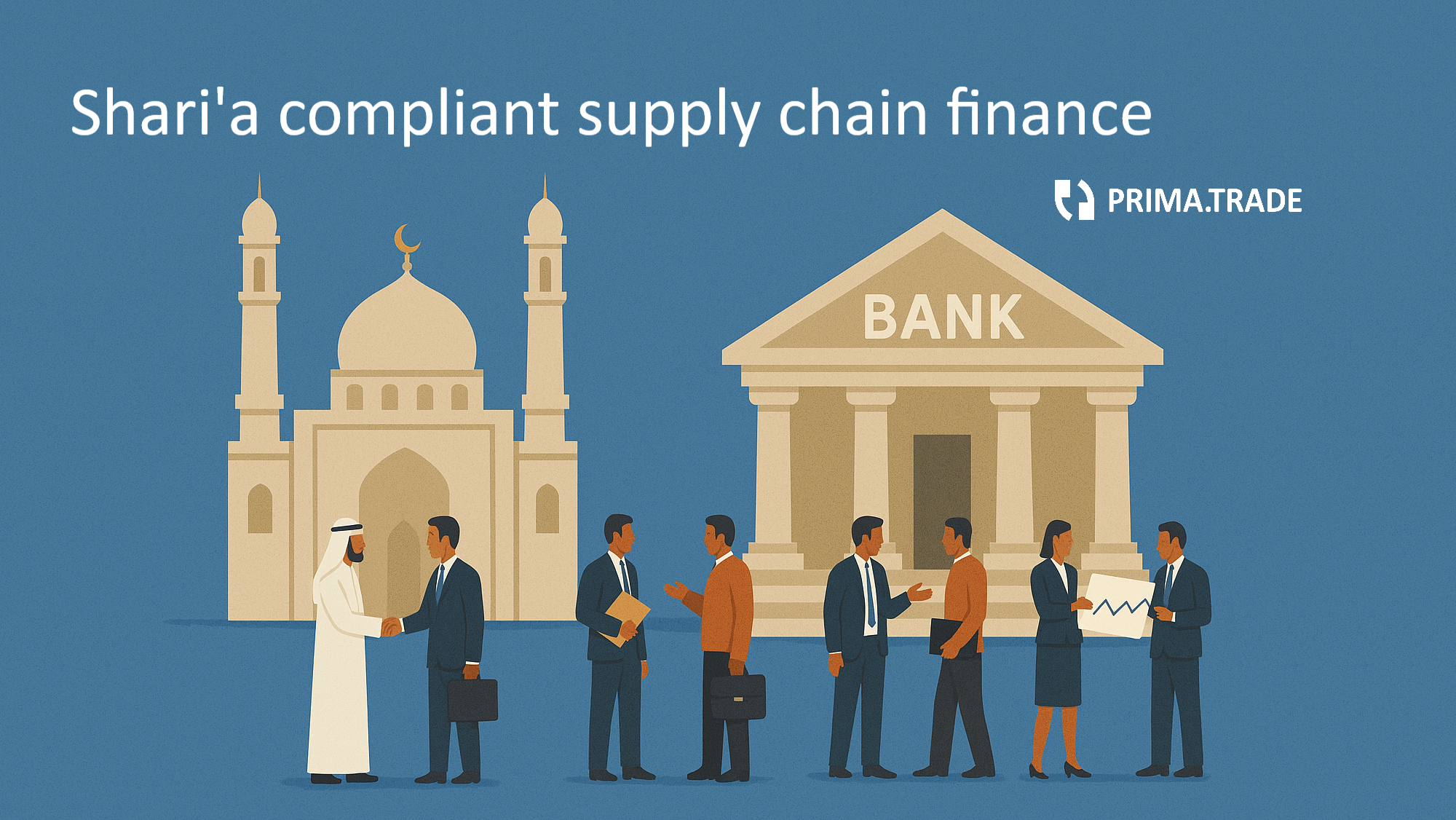
PrimaTrade: Shari'a compliant supply chain finance
Our platform can support a number of different approaches.
This note sets out just one of the models that we have developed for clients who would like their financing arrangements to be implemented in compliance with Shari'a law; it has been reviewed by scholars and Fatwas have been issued (case-by-case) to clients in respect of its use.
The Shari'a compliant SCF model described here is supported natively by the PrimaTrade platform.
A key feature of our structures and approach is to provide operationally efficient and scalable outcomes for our clients. This also drives, to some extent, how structures work in practice.
Whether a structure or financing model is acceptable or not is always a matter of analysis and opinion - and this should be borne in mind. Our approach is to be flexible in this area and, within practical limits, to accommodate any points that might be raised by scholars reviewing the arrangements.
Subject matter of transactions: who and what
The services that PrimaTrade supports for its customers (suppliers, buyers and funders) aim to be Halal (ie: compliant with Shari’a law), and aim to avoid the Bay Al-Dahn model.
The parties are:
Funder (for example, a trade finance fund or bank)
Seller (typically a supplier of goods to the buyer)
Buyer (a corporate business purchasing goods from the Seller)
At the heart of the arrangements is the invoice or invoices issued by the Seller to the Buyer for the goods (the "Invoice").
Invoices are issued by Sellers to Buyers at shipment, but are due for payment much later and subject to uncertainty (Incoterms of FOB or similar are assumed).
As a result, the market value of any Invoice is less than its face value at the time of issuance.
The purpose of the arrangements is to establish a partnership between Funder and Seller to share in the risk of collection from the Buyer and to cooperate with a view to maximising the amount collected.
The financing need
Buyers expect to work on sale contract (open account) and to benefit from deferred payment terms - so goods are shipped and payment to the Seller comes 30/60/90 days later.
Working on this basis creates a working capital problem and risk for the Seller; the Seller needs money (typically) at shipment to repay local finance drawn to purchase the materials and pay the wages involved in producing the goods.
The financing process
The financing service works specifically as follows:
At shipment:
At shipment, the Seller provides scan copy documents over the PrimaTrade platform to the Buyer that evidences the delivery of the goods that have been ordered. The Seller uses our platform to extract the data from the scan copy documents to create a fully digitized transaction.
The Seller digitally signs an agreement on the PrimaTrade platform (eg: using our Docusign integration) automatically created by the platform based on the trade data the Seller has provided.
This agreement offers the Invoice for sale to the Funder. We call this agreement the Invoice Purchase Agreement (or “IPA”).
The IPA:
The IPA provides for an immediate payment to the Supplier (the "Purchase Amount") and then later, a share of a "Profit Amount" if a profit arises because more than the Purchase Amount has been collected.
The Purchase Amount is less than the face value of the Invoice and reflects the agreed current “value” of the Invoice as between the Seller and the Funder. Typically, this agreed value is up to 95% of the face amount of the Invoice.
The Funder's share of any Profit Amount is allocated to it first, and the balance of the Profit Amount is the Seller's share.
The Buyer confirmation:
The Buyer reviews the data and scan copy documents and the IPA.
The Buyer confirms to the Funder that it will pay the invoice without deduction on its later due date in an amount at least equal to the Purchase Amount or such higher figure as the Funder requests.
Payment (initial payment by Funder):
The Funder purchases the Invoice offered to it by the Seller via the IPA by making the payment of the Purchase Amount to the Seller.
The ownership of the Invoice (or at least the right to payment from the Buyer in respect of the Invoice) transfers to the Funder as set out in the IPA.
After shipment (later payment by the Buyer):
Working with the Seller, the Funder works to collect the face amount of the Invoice on its due date from the Buyer (who may reside in a remote geography).
The payment from the Buyer is made to the Funder.
Profit share and risk allocation:
The Funder retains an amount equal to the Payment Amount and then its share of the Profit Amount.
The balance of the Profit Amount is paid to the Seller.
There are three potential outcomes:
Working with the Seller, the Funder successfully collects the Invoice debt. Amounts received in excess of the Purchase Amount are the Profit Amount and are shared with the Seller on the basis agreed at the start and documented in the IPA.
The Buyer defaults and there is a loss. The Funder takes a loss in respect of the Purchase Amount that it has paid (which is non-returnable); the Seller takes a loss (as it will have received only the Purchase Amount which is less than the face amount of the Invoice).
The Buyer successfully disputes its obligation to pay because of a defect in the goods or service provided by the Seller and so pays less than the full amount of the Invoice. The Seller will initially take this loss up to its share of the Profit Amount and the Funder will then take the balance of any further loss.
The PrimaTrade platform automatically administers these arrangements, the legal agreements, accounting entries for the Buyer, the cash flows and payments, and the processes end-to-end.
Are these arrangements compatible with other PrimaTrade innovations?
All of the exceptional capabilities of the PrimaTrade platform can overlaid onto these arrangements, including:
True multi-Funder (one Supplier can access multiple Funders at the same time including the Buyer itself - and each Funder can operate with its own paperwork automatically managed on the PrimaTrade platform)
Integrated and dynamic use of own funds (Buyer treasury funds can be seamlessly mixed in to provide early payments to any Supplier any time)
Monetisation of discounts (if the Supplier agrees an early payment discount with the Buyer separately to the arrangements with any Funder, the Buyer can receive a P&L win, all fully-managed by us - and our clients have been able to maintain a trade payables accounting treatment)
The Purchase Amount can be set at any level (the amount paid early can be varied by Seller and can be less than the full amount of the Invoice - which helps to ensure a trade payable accounting treatment for the Buyer and to manage the dilution risks for Buyers and Funders)
Real-time management of debit and credit notes, and optional management by us of payments to Sellers and Funders
Real-time legal agreements (via our Docusign integration, Supplier paperwork is generated invoice-by-invoice in real-time, including the IPA with all the required language and calculations to support the Shari'a compliant approach)
Support for payment term extensions (electronic bills of exchange, use of payment agents that enable working capital benefits for Buyers on top of the Invoice term)
A Shari’a perspective on the arrangements
The key features of the service are documented in the IPA and other agreements between the Funder, Buyer and Seller. The IPA is created and signed automatically each time the Seller ships goods to the Buyer:
The parties to the agreements (Funder, the Buyer and Seller of goods or services) specifically intend that the arrangements shall be compatible with the principles of Shari’a on the basis of al-kharaj bi-al-daman.
The IPA is a partnership based upon Mudaraba or Musharakah.
The basis of the agreement is a working partnership between the Funder and the Seller in respect of a joint business activity (the successful collection of the sum due from the Buyer) with a view to sharing in a profit made if more than the Purchase Amount can be collected.
The Seller formally confirms (in the IPA) that:
The goods involved are not for haram use and confirms the absence of gharar in the arrangements.
There is no “riba” (ie: interest) involved in the arrangements.
The calculation of the profit share is based upon mutual cooperation as follows:
The Funder is responsible for debt collection services, customer communication and management, monitoring, and documentation services - noting that the Buyer is often in a different country to the Seller. The Funder may delegate some or all of these responsibilities to PrimaTrade.
The Seller is responsible for the maintenance of good commercial relations with the Buyer, full performance of its obligations under the purchase orders, remedying any issues arising, providing assistance to support the Funder's collection process.
The invoice will not be due for payment at the time it is purchased by the Funder from the Seller by settling the Purchase Amount on the Seller. There are a number of risks and uncertainties relating to the collection and the amount that may be collected under the invoice from the Buyer.
These risks and uncertainties are shared between the Seller and the Funder, as are the rewards for collecting an amount in excess of the Purchase Amount initially paid.
The price paid for the Invoice and the basis on which risks and rewards are shared are both determined on or before the date when the invoice is purchased by the Funder.
At no time does the Funder make a charge to the Seller or apply any form of penalty to the Seller – the Funder's own costs are always covered out of the profit-sharing arrangement in respect of the Profit Amount.
Getting in touch
If you would like to know more about the details of this product or discuss other types of Islamic finance that we can support on our platform - please get in touch: