
SCF's return on investment
It is a tough world out there.
Resources are tight, budgets are squeezed, shareholders expect businesses to perform and CFOs are under pressure.
Supply chain finance has historically under-delivered for many companies. But that's down to programme design and platform capability - not because the product is weak.
Here's how existing SCF programmes can be upgraded and how to calculate the return on investment ("ROI") that can be delivered.

And a strong ROI is the key to getting internal resources allocated, projects approved, delivered and benchmarked.
Where is the ROI for supply chain finance?
Most supply chain finance projects historically have focussed on generating working capital for corporate treasuries. There's nothing wrong with that; working capital is an important KPI for most finance teams, and that used to be enough to enable an SCF project to start.
But our experience in 2026 is that a working capital win by itself is no longer sufficient to gain the attention of a busy CFO. Working capital is an important KPI but improving working capital has only marginal impacts on P&L.
In today's market, we need direct P&L wins, ideally above the line (so operating P&L) in addition to working capital improvement before projects can get a green light.
PrimaTrade uniquely delivers both P&L and working capital wins - and so PrimaTrade projects can compete for resources and attention given the scale of benefits that can be delivered.
Where is the P&L win for supply chain finance?
There are two important dimensions here:
Suppliers benefit significantly from early payments, particularly if they can be paid when goods are handed over and before delivery.
Why do suppliers benefit? Because they often end up financing customer invoices with equity, especially if customers are international.
How does this become buyer P&L? The early payment at shipment provides liquidity, reduces risk and releases financial resources for their business - and suppliers can often agree a discount of several percent. on the invoice face value to get paid really fast.
Smaller suppliers often have limited access to liquidity and value early payments at shipment much more than larger suppliers.
But reaching the long tail requires automation and efficiency.
This can only come from a fully digital platform that can integrate purchase orders and all trade documents - without disturbing the existing ERP operations.
Deliver on these two points, and the P&L becomes visible.
Even if smaller suppliers are a smaller part of overall spend, here is where the significant P&L wins can be obtained - and they come simply from more efficient management of cash and not from tougher negotiations.
Calculating SCF's return on investment
PrimaTrade usually works fixed price with its clients to get supply chain finance up and running.
A go-live process might cost €50,000 to €150,000 and typically takes three months from inception to live operation at scale. This is a one-off investment and covers the standard IT work that is involved. There's no upfront licence fee.
This sum can be recovered from suppliers via early payment discounts within weeks. For example, a €100m of spend over a year yielding a 1% net early payment discount can recover the one-off costs within a month or so.
Early payment discounts save €1m per year net of costs - so that's €83k per month.
The upfront investment to go live is earned back by the end of month 2.
It is a short and snappy project - with a guaranteed payback measured in weeks - and with low risks for delivery.
And where is procurement in all this?
That's the magic of supply chain finance programmes that bring P&L as well as working capital.
Supplier relationships are generally owned by procurement - but working capital is not a procurement KPI. So corporate treasurers can find that access to suppliers to implement supply chain finance is difficult.
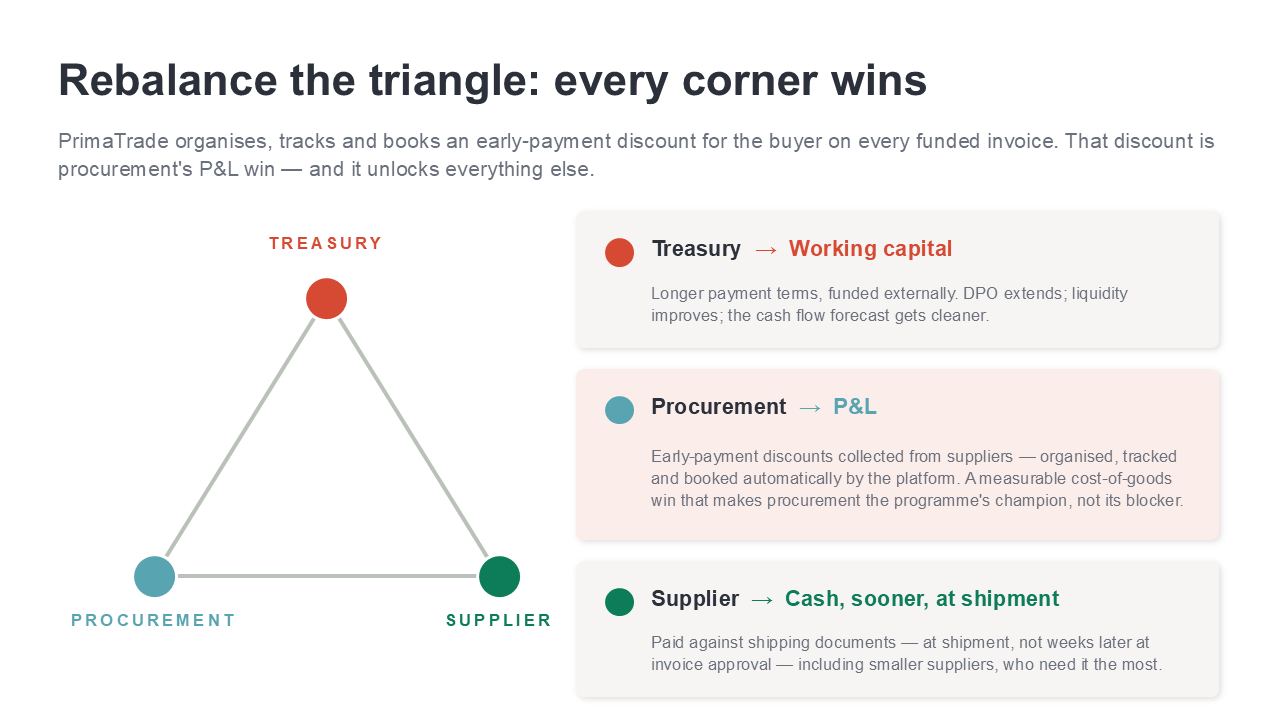
But once SCF can generate both working capital and P&L wins, the problem gets solved.
Allocate the P&L win to procurement, take the working capital win into treasury. Everyone is pulling together.
Get in touch
Do get in touch with us to discuss further - we are happy to share insights on AI and to explain more about "ERP wrap-around" solutions in SCF to enhance your programs.
PrimaTrade enables you to extract the value already sitting in your supply chain by implementing SCF programs that meet the supply chain finance best practice guidelines.
If you’d like to see how supply chain finance could work for your business, we would be glad to talk: