
ISO20022 and trade digitization
Compliance responsibilities for corporate treasurers are increasing.
In fact, it's not just ISO20022, there is a wide range of new requirements coming through the door with a bewildering set of acronyms (like PSD3, DORA, CBPR+, CESOP, ECCTA and so on).
What's going on?
A treasurer walks into a bar. The bartender says, "What'll you be having then?"
The treasurer says, "It depends. Please specify your question in structured XML with purpose code, remittance info, and party identifiers - as otherwise I can't process it ."
Two things are happening:
Governments want to know about your transactions and so want you to provide more data
The data you provide needs to be formatted into structured fields so other systems can understand it - no more "free text".
Why is this hard?
The source for most payment instructions in a corporate world is the "ERP" - the accounting system.
Most accounting systems were built to do accounting, and not to capture rich operational and compliance details of the transactions involved.
So three challenges are emerging:
Where is the data we need? It might not be conveniently available in the ERP.
When is the data we need? We might not yet have it at the time we actually want it.
How do we get the data securely included into payment messages?
These are all hard steps - made more difficult by the fact that migration from one standard to another typically involves "coexistence" when both systems are running at the same time until one is switched off.
Why is trade digitization relevant to ISO20022?
Digitizing international trade makes digital connections between exporting suppliers and importing buyers to capture [all] the details of what is being shipped with payments flowing the other way.
Trade digitization addresses a simple problem which is that most of the data about a cross-border shipment and its subject matter is still on paper and hard to use.
It also addresses timing - because data is provided as soon as goods are handed over, not later after delivery. Most ERPs are only updated after delivery.
An efficient trade digitization platform (eg: PrimaTrade) enables the exporting suppliers to self-digitize their paperwork, providing 100-200 data fields that fully describe their transaction, including structured addresses for all counterparties. Data ranges from matched purchase orders, packing lists, invoices through to commercial codes for customs and duty payments and origin information.
Trade digitization platforms, if requested, can do compliance and sanction checks - with the data integrated into the platform. It is part of the service that they can provide.
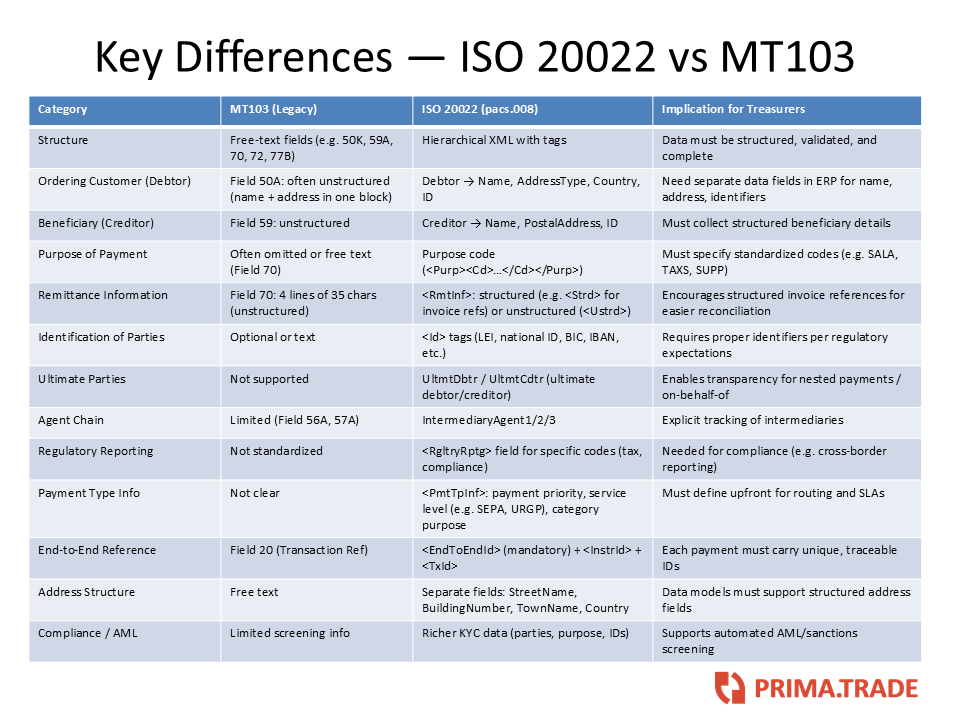
The new messaging formats need structured "standing data" but can also require dynamic information about the purpose of the transaction, its duty characteristics and other fiscal details.
Exporter data - is that the key?
Locating the data needed to drive the new messaging and reporting standards is only the start.
But the key points here are:
the exporting supplier has data that you need when you need it - but typically lacks an easy way to provide it, PO-by-PO, shipment-by-shipment; and
the importing buyer usually does not have a convenient and secure place to put that data which is connected to the payment process.
But this is exactly what the new breed of trade digitization platforms (like PrimaTrade) sorts out.
Moreover, with relatively new technology stacks, the new breed of trade digitization platform also automatically copes with LEIs, structured address formats and the disciplines that are needed to manage data well.
ISO20022 not solved - but helped massively
If you are wrestling with ISO20022 and how to populate the new message formats for cross-border supplier payments, then the new breed of trade digitization platforms is likely one of the data sources that you are looking for.
Give us a call or send us an email to discuss!